You are here: > > Lost Mr. Blake
Lost Mr. Blake
Fun n.s. VIII - 28th Nov. 1868
| Mr. Blake was a regular out-and-out hardened sinner, | ||
| Who was quite out of the pale of Christianity, so to speak: | ||
| He was in the habit of smoking a long pipe and drinking a glass of grog on Sunday after dinner, | ||
| And seldom thought of going to church more than twice (or if good Friday or Christmas Day | ||
| happened to come in it) three times a week. | ||
| He was quite indifferent as to the particular kinds of dresses | |
| That the clergyman wore at the church where he used to go to pray, | |
| And whatever he did in the way of relieving a chap's distresses, | |
| He always did in a nasty, sneaking, underhanded, hole-and-corner sort of way. | |
| I have known him indulge in profane, ungentlemanly emphatics, | |
| When the Protestant Church has been divided on the subject of the width of a chasuble's hem; | |
| I have even known him to sneer at albs — and as for dalmatics, | |
| Words can't convey an idea of the contempt he expressed for them. | |
| He didn't believe in persons who, not being well off themselves, are obliged to confine their | ||
| charitable exertions to collecting money from wealthier people, | ||
| And looked upon individuals of the former class as ecclesiastical hawks; | ||
| He used to say that he would no more think of interfering with his priest's robes than with his | ||
| church or his steeple, | ||
| And that he did not consider his soul imperilled because somebody over whom he had no | ||
| influence whatever, chose to dress himself up like an ecclesiastical Guy Fawkes. | ||
| This shocking old vagabond was so unutterably shameless | ||
| That he actually went a-courting a very respectable and pious middle-aged sister, by the name | ||
| of Biggs: | ||
| She was a rather attractive widow whose life, as such, had always been particularly blameless; | ||
| Her first husband had left her a secure but moderate competence owing to some fortunate | ||
| speculations in the matter of figs. | ||
| She was an excellent person in every way--and won the respect even of Mrs. Grundy, | ||
| She was a good housewife, too, and wouldn't have wasted a penny if she had owned the | ||
| Koh-i-noor; | ||
| She was just as strict as he was lax in her observance of Sunday, | ||
| And being a good economist, and charitable besides, she took all the bones and cold | ||
| potatoes and broken pie-crusts and candle-ends (when she had quite done with them), and made them into an excellent soup for the deserving poor. | ||
| I am sorry to say that she rather took to Blake — that outcast of society; | ||
| And when respectable brothers who were fond of her began to look dubious and to cough, | ||
| She would say, "Oh, my friends, it's because I hope to bring this poor benighted soul back to | ||
| virtue and propriety" | ||
| (And besides, the poor benighted soul, with all his faults, was uncommonly well off). | ||
| And when Mr. Blake's dissipated friends called his attention to the frown or the pout of her, | |
| Whenever he did anything which appeared to her to savour of an unmentionable place, | |
| He would say she would be a very decent old girl when all that nonsense was knocked out of her — | |
| And his method of knocking it out of her is one that covered him with disgrace. | |
| She was fond of going to church services four times every Sunday, and four or five times in the | ||
| week, and never seemed to pall of them, | ||
| So he hunted out all the churches within a convenient distance that had services at different | ||
| hours, so to speak; | ||
| And when he had married her he positively insisted upon their going to all of them, | ||
| So they contrived to do about twelve churches every Sunday, and, if they had luck, from | ||
| twenty-two to twenty-three in the course of the week. | ||
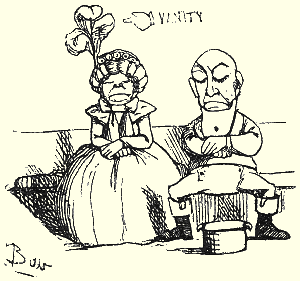
| She was fond of dropping his sovereigns ostentatiously into the plate, and she liked to see them | ||
| stand out rather conspicuously against the commonplace half-crowns and shillings, | ||
| So he took her to all the charity sermons, and if by any extraordinary chance there wasn't | ||
| a charity sermon anywhere, he would drop a couple of sovereigns (one for him and one for her) into the poor-box at the door: | ||
| And as he always deducted the sums thus given in charity from the housekeeping money, and the | ||
| money he allowed her for her bonnets and frillings, | ||
| She soon began to find that even charity, if you allow it to interfere with your personal luxuries, | ||
| becomes an intolerable bore. | ||
| On Sundays she was always melancholy and anything but good society, | ||
| For that day in her household was a day of sighings and sobbings and wringing of hands and | ||
| shaking of heads: | ||
| She wouldn't hear of a button being sewn on a glove, because it was a work neither of necessity | ||
| nor of piety, | ||
| And strictly prohibited her servants from amusing themselves, or indeed doing anything at all | ||
| except dusting the drawing-rooms, cleaning the boots and shoes, cooking the dinner, waiting generally on the family, and making the beds. | ||
| But Blake even went farther than that, and said that, on Sundays, people should do their own works | ||
| of necessity, and not delegate them to persons in a menial situation, | ||
| So he wouldn't allow his servants to do so much as even answer a bell. | ||
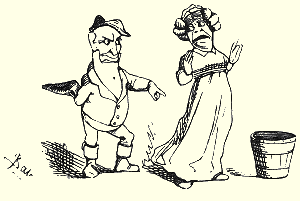
| Here he is making his wife carry up the water for her bath to the second floor, much against her | ||
| inclination, — | ||
| And why in the world the gentleman who illustrates these ballads has put him into a cocked hat is | ||
| more than I can tell. | ||
| After about three months of this sort of thing, taking the smooth with the rough of it | ||
| (Blacking her own boots and peeling her own potatoes was not her notion of connubial bliss), | ||
| Mrs. Blake began to find that she had pretty nearly had enough of it, | ||
| And came, in course of time, to think that Blake's own original line of conduct wasn't so much | ||
| amiss. | ||
| And now that wicked person — that detestable sinner ("Belial Blake" his friends and well-wishers | ||
| call him for his atrocities), | ||
| And his poor deluded victim whom all her Christian brothers dislike and pity so, | ||
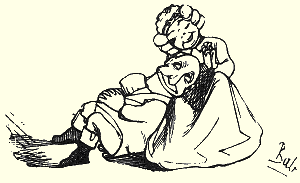
| Go to the parish church only on Sunday morning and afternoon and occasionally on a | ||
| week-day, and spend their evenings in connubial fondlings and affectionate reciprocities, | ||
| And I should like to know where in the world (or rather, out of it) they expect to go! | ||
| |
Page Created 29 July, 2011